
Fitzy FAQ
What Is Fitzy, and How Does It Actually Work?
A plain-English guide for shop owners — no jargon, no assumptions that you're a developer. If you've ever wondered how a "software platform" sells physical wheels and tires, start here.
What is Fitzy by Fitted Rims?
Fitzy is an end-to-end B2B ecommerce platform and marketplace built for automotive service, detailing, and wrapping shops that want to sell wheels and tires online — without buying or storing a single physical unit.
It gives your shop virtual access to over $100 million in combined live inventory (1M+ SKUs) from major tire and rim brands. An automated fitment database checks bolt patterns, offsets, and clearances the moment a customer enters their vehicle, so every result is a guaranteed match. When an order comes in, Fitzy coordinates with the supplier, processes payment, and manages logistics — shipping to the customer's door or straight to your shop for installation.
It was built by Limitless Tire Group, a Canadian automotive service franchise founded in 2008, to run their own multi-location operation — then commercialized for the rest of the North American automotive retail market.
"Fitzy is a wheel and tire e-commerce platform that helps entrepreneurs, tire shops, repair shops and automotive businesses launch and operate an online wheel and tire store using vehicle-fitment technology, supplier integrations, product-management tools and e-commerce infrastructure without building the entire system themselves."
How It Works, Step by Step
Forget the tech talk for a second — here's what actually happens between a customer's request and the money landing in your bank account.
A customer asks for something you don't stock
“I want 20-inch black rims for my 2024 Civic.” Normally you'd have to say no, or spend an hour calling warehouses.
You open Fitzy on a tablet, phone, or your website
No physical inventory required — Fitzy is software, not a box of parts shipped to your shop.
You type in their vehicle
The fitment engine instantly filters hundreds of live-inventory rims down to only the ones guaranteed to bolt onto that exact car.
The customer picks a set and pays your price
They pay in full, right there — on the tablet, on your site, or over the phone. Financing (Affirm/Snap) is built into checkout.
Fitzy splits the payment automatically
The wholesale cost routes straight to the supplier. Your markup deposits directly into your shop's bank account. You never float your own cash.
The order ships — to them or to you
Send it to the customer's door, or to your shop so you can install it and collect an extra fee for the work.
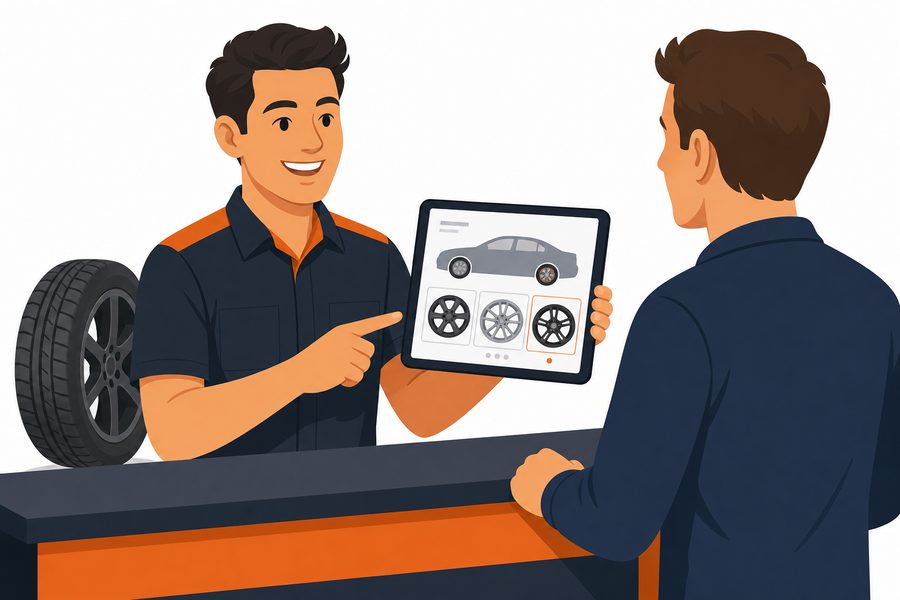
Think of it like a digital vending machine
Except instead of snacks, it sells rims and tires. A customer wants 20" black rims for their F-150 — you don't have any in the back room, so you hand them a tablet. They type in their truck, see hundreds of guaranteed-fit options, and pay right there. The warehouse ships the rims to your door a couple days later. You install them and collect a fee on top of the profit you already made on the sale — all without spending your own money on inventory.
What Fitzy Replaces
Without an engine like Fitzy, selling wheels and tires online means manual labor, capital investment, and a lot of industry-specific guesswork. Here's what shops typically deal with instead.
Siloed wholesale accounts
Applying individually for credit lines with dozens of local distributors (ATD, TireHub, independents) before you can even see wholesale pricing.
Manual catalog digging
Logging into 3–4 outdated B2B supplier portals at once just to check stock, compare prices, and find your margin.
DIY Shopify / WooCommerce
Paying thousands for third-party “year/make/model” plugins, then manually managing thousands of SKUs and re-pricing by hand.
Stocking a physical showroom
Tying up real cash in 50–200 common sizes — and still losing the sale when a customer's vehicle needs something you didn't stock.
Marketplace flipping (FB/eBay)
One-off cash sales with constant back-and-forth messaging — it doesn't scale and doesn't capture people searching for guaranteed-fit product.
Fitzy replaces all of it
One live inventory feed, one automated fitment engine, one checkout — no applications, no guesswork, no upfront cash.
See the full cost breakdown: building it yourself vs. Fitzy →
How Do I Get It?
It's cloud-based software — no hardware to install and nothing to code yourself. Most shops are live within 24 hours.
Book a demo
A 30-minute walkthrough of the backend, where you discuss markup goals and set up your account.
Send your branding
Your shop name, logo, and color scheme — that's it.
Your store is built
Pre-loaded with $100M+ in live inventory from major wheel and tire brands, ready to sell.
Set your markup
Decide your profit margin per brand, e.g. “20% on Michelin, +$150 flat on Vossen.”
Go live — within 24 hours
Embed it on your site, share the link on social, or run it on a waiting-room tablet.
How Do You Actually Get Paid?
You never float your own cash to buy inventory. Here's exactly where the money goes when a customer checks out.
Customer pays
Full retail price at checkout
e.g. $2,000 for a rim & tire package
Supplier gets
Wholesale cost, instantly
e.g. $1,400 to release the parts
Your shop keeps
The profit margin
e.g. $600 deposited to your bank
Zero-Risk model — $0/mo
No monthly fee. You earn 10% of the profit on every sale through your link; Fitzy keeps the rest and handles all fulfillment and supplier payments.
Subscription model — $500–$650/mo
Plus a one-time $2,500 setup fee. Best for established shops — you keep 100% of your retail profit margin.
How Is It Added to My Website?
You don't rewrite your site or touch a line of code. It's copy-and-paste technology — think of it like embedding a YouTube video, not building a video player.
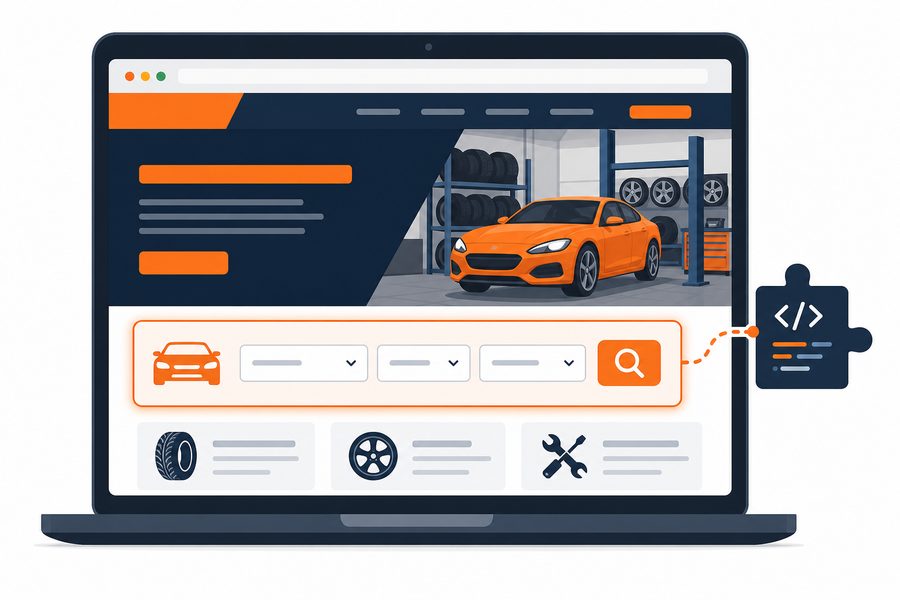
The widget (most shops)
Fitzy's team generates a small snippet of code tied to your store and branding. It gets pasted into your existing WordPress, Shopify, Squarespace, or Wix site — usually onto your homepage or a new “Shop Wheels” page. A “Search by Year, Make, Model” box appears instantly, styled to match your site.
The subdomain (no existing site needed)
Fitzy hosts a full, white-label storefront on its own servers, branded with your logo and colors. You just add a “Shop Wheels & Tires” button on your main site that links out to it — or use it standalone if you don't have a website yet.
Not sure how, or don't have a "website person"? Give Fitzy's team temporary access to your site builder and they'll paste it in for you, test a checkout, and make sure it looks right on mobile and desktop before handing it back.
Full FAQ
Is Fitzy a physical product I install in my shop?
No. Fitzy is software — a website tool you use on a tablet, phone, or computer. You're not buying or stocking any physical parts. Think of it as an instant digital storefront: it connects your customers to over $100M in live supplier inventory without you ever holding stock.
Do I need to know how to code, or do they build an app for me?
You don't need to write any code, and they don't build you a brand-new app from scratch — the engine is already built. It's the same idea as signing up for Netflix or Shopify: the hard technical work (fitment database, supplier connections, checkout, financing) is already done. You just apply your branding and turn your account on.
How long does it take to go live?
Most shops are live within 24 hours of their demo call. You send your logo, shop name, and color scheme; Fitzy's team builds and pre-loads your store with live inventory while you set your markup rules.
What if I don't have a website at all?
That's fine — Fitzy can build and host a complete, customized storefront for you (starting around $29/mo) instead of you needing an existing site to embed a widget into.
How do I actually get paid?
A customer pays your full retail price at checkout (via Stripe). The system automatically routes the wholesale cost to the supplier and deposits your profit margin straight into your shop's bank account — you never spend your own money on inventory up front.
What happens if a customer orders the wrong fitment?
Fitzy's fitment engine checks bolt pattern, offset, and clearance automatically before checkout, so mismatches are rare. If something still doesn't fit, Fitzy handles the return logistics and supplier communication — your shop isn't stuck doing the paperwork or eating the cost.
Can I use it purely as an in-shop tool, without selling online at all?
Yes. Plenty of shops run Fitzy only as a waiting-room kiosk: a technician pulls up a customer's vehicle on a tablet at the counter, builds the order on the spot, and closes the sale without ever touching your website.
What does it cost?
Two options: a $0/mo revenue-share plan where you keep 10% of the profit and Fitzy handles everything, or a $500–$650/mo subscription (plus a one-time $2,500 setup fee) where you keep 100% of your markup. See the full breakdown on the Pricing page.
How is Fitzy added to my website — do I need to understand code?
Think of it like embedding a YouTube video. Fitzy's team generates a short widget snippet for your store. You (or anyone who edits your site) paste it where you want Shop Wheels & Tires to appear — WordPress, Shopify, Wix, Squarespace, or similar. If that still feels scary, give Fitzy temporary access and they'll paste it for you.
How does the money split work when a customer pays?
Example: a customer buys a $2,000 wheel package. They pay $2,000 at checkout via Stripe. Fitzy routes the wholesale product cost (say $1,400) to the supplier and deposits your markup (say $600) into your shop's bank account. You never float inventory capital to release the order.
What's the simplest way to explain Fitzy to my staff?
Put a tablet on the counter. Customer wants rims for their truck — they type the year/make/model, pick a set, and pay. A warehouse ships the parts to your shop (or their house). You install and keep the profit. No stockroom of rims required.
Can I use Fitzy without having any suppliers?
Yes — that's the point. You sell under Fitzy's master relationships with 75+ integrated wheel and tire suppliers. You don't apply to a single distributor, and supplier access is live the day your store launches.
Do I need to purchase inventory?
No. You sell from live supplier stock. The customer pays your retail price at checkout, the wholesale cost routes to the supplier, and the supplier ships. Holding your own inventory is optional, not required.
Do I need wheel and tire experience?
No. The fitment engine handles bolt patterns, offsets, center bores, and tire sizing automatically — customers only see products verified to fit their exact vehicle. You need business and marketing effort, not automotive expertise.
Can I use my own domain?
Yes. Stores run on your own domain or a subdomain like shop.yourbusiness.com. The Fitzy team handles the domain mapping during onboarding.
Can I keep my existing website?
Yes. The embeddable widget adds the full vehicle-search and checkout experience to your current WordPress, Shopify, Squarespace, or Wix site without changing its design. Nothing about your existing site needs to be rebuilt.
Can I control my own prices?
Yes — completely. You set markup rules in the dealer dashboard (flat amounts or percentages, per brand or product type), and retail prices recalculate automatically whenever wholesale costs change.
Can I choose which brands I sell?
You control your catalog through your markup rules per brand, and can price brands to promote or discourage them. Discuss specific brand curation needs on your demo call so they're scoped accurately for your store.
Who handles customer service?
You own the customer relationship — buyers are your customers, on your brand. Behind the scenes, Fitzy handles supplier coordination, fulfillment support, and return logistics so you're not the freight department.
Who verifies vehicle fitment?
The platform does, automatically, before payment. When a customer enters their year, make, and model, the fitment engine constrains the catalog to verified-compatible products — incompatible items can't be purchased.
Who handles shipping, returns, and warranties?
Suppliers ship from their warehouses via freight carriers, with tracking surfaced through the platform. Fitzy coordinates supplier-side returns per the published policy. Warranties are the manufacturer's, honored through the supplier, with Fitzy coordinating claims.
Who is responsible if a product doesn't fit?
Fitment errors are blocked before payment by design, which is why they're rare. When a confirmed fitment issue does occur, Fitzy coordinates the return with the supplier under the fitment policy — your shop doesn't eat the freight fight alone.
Can customers ship orders to an installer instead of their house?
Yes. At checkout, orders can ship to the customer's address, to your shop, or to a designated installer for mounting and balancing.
Does Fitzy work in Canada and the United States?
The platform serves shops in both the US and Canada — it was built by Limitless Tire Group in Canada. Supplier fulfillment ships across the contiguous US; coverage for your exact region is confirmed on the demo call.
Are there setup fees or transaction fees?
The subscription plan has a one-time $2,500 setup fee plus $500–$650/month, and you keep 100% of your markup — Fitzy takes no cut of your sales on that plan. The revenue-share plan has no setup fee and no monthly fee. Standard Stripe card-processing rates apply to checkout on any plan.
Can I cancel?
Cancellation terms are set out in the dealer agreement you receive during onboarding — ask for it on the demo call to review before committing. The revenue-share plan carries no monthly fee to begin with.
Who owns the website and customer data?
Your brand, domain, and customer relationships are yours. The storefront runs on Fitzy's managed platform rather than being source code you self-host. The specific data-export and ownership terms are in the dealer agreement — request them explicitly if this is a deciding factor.
What happens if a supplier is out of stock?
Live inventory sync removes out-of-stock items from your catalog before they can be ordered. If stock changes between order and fulfillment, Fitzy re-sources from another integrated supplier or resolves the order with the customer.
Can I connect my own payment processor?
Not currently — checkout is standardized on Stripe, which is what enables the automatic wholesale/markup split and direct payouts to your bank account.
Can I offer financing?
Yes. Affirm and Snap financing are built into checkout. Customers split their payments; you receive your full markup up front.
Still have questions?
Book a 30-minute demo and we'll walk through your specific setup, markup goals, and how fast you can go live.